
Cost of AI implementation in 2026: realistic budget ranges
Cost of AI implementation in 2026: budget ranges, hidden costs, ROI math, and when a pilot is worth it for mid-sized teams.

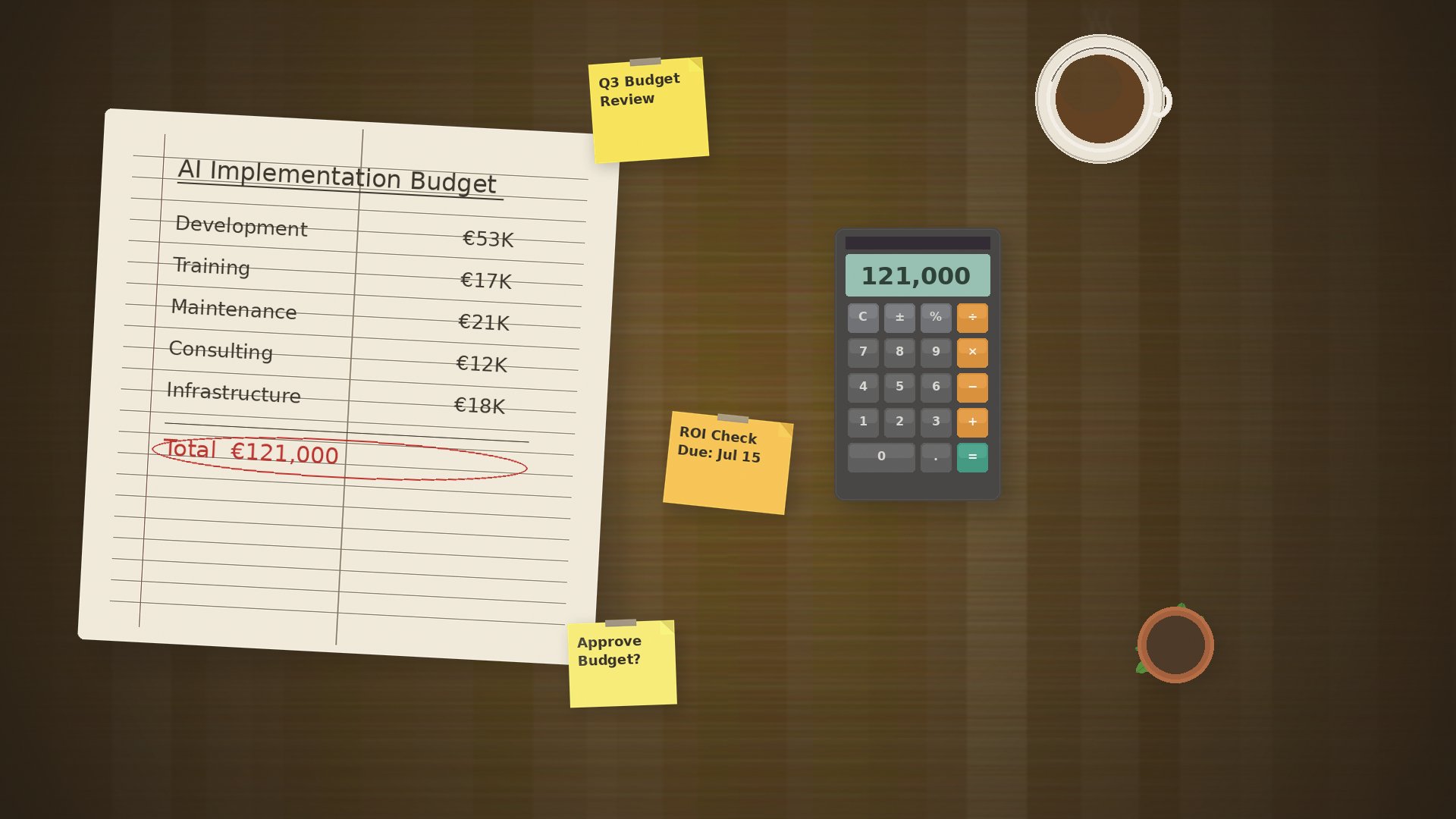
The cost of AI implementation is usually discussed too late. A team gets excited about a model demo, someone asks for a budget, and only then do people notice the work around the model: data access, review screens, permissions, testing, training, and maintenance.
That is where many AI projects become expensive. Not because the model call costs a fortune. Because the business workflow was never priced properly.
If you are planning AI automation in 2026, use this as a practical budgeting guide. The numbers below are planning ranges, not fixed quotes, but they are useful enough to decide whether a pilot is worth discussing.
For a finance-specific example, see our guide to AI automation for finance teams; it shows how to scope invoice intake, approvals, and ROI without weakening controls.
Cost of AI implementation: realistic budget ranges
For small and mid-sized companies in Europe, the cost of AI implementation usually falls into four buckets:
A document classification pilot is near the low end if the data is clean. A support triage workflow connected to Zendesk, HubSpot, Slack, and an internal knowledge base sits higher. An AI assistant that touches customer data, financial records, or regulated decisions needs more engineering, more testing, and more governance.
The budget should match the risk of the workflow. A tool that drafts internal meeting notes can fail softly. A system that updates invoice data cannot.
What changes the cost of AI implementation?
The model is rarely the largest cost. The expensive parts are the pieces that make the model useful inside a real company.
Common cost drivers:
A good implementation plan prices these items from the start. A bad one says "we will connect it later" and discovers later that the integration is the project.
Pilot first, platform later
The safest way to control AI implementation cost is to start with one workflow. Not a company-wide AI platform. One workflow with volume, pain, and a clear owner.
A useful pilot brief looks like this:
That kind of brief lets you estimate scope. It also gives you a clean kill condition. If the pilot does not save time or reduce errors, stop. Do not keep funding AI because the demo looked good.
For the implementation sequence, see our 90-day AI implementation roadmap. This cost guide is the budget layer that sits next to that plan.
Hidden AI implementation costs teams forget
The obvious costs are discovery, design, development, model usage, and hosting. The less obvious costs show up after the pilot starts touching real work.
First: review time. If every AI output needs human approval, budget for that time. The goal is not to remove review entirely. The goal is to make review faster than doing the task manually.
Second: bad data. Old spreadsheets, inconsistent field names, missing document IDs, and duplicate customer records can turn a two-week prototype into a two-month cleanup effort.
Third: maintenance. Prompts change. APIs change. Teams change the process. Someone needs to watch errors, update examples, and decide when the system should be retrained, rewritten, or retired.
Fourth: security work. If the workflow uses personal data, contracts, source code, or client documents, you need rules for what can leave your environment and what must stay private.
How to calculate AI ROI before you build
Keep the math simple. Start with the current cost of the workflow.
Example: a team processes 600 customer requests per month. Each request takes 7 minutes. That is 70 hours monthly. If the fully loaded cost of that work is €45 per hour, the workflow costs about €3,150 per month before mistakes, delays, and rework.
If AI saves 40% of the handling time, the gross time saving is about €1,260 per month. Now subtract model usage, hosting, maintenance, and review time. If the net saving is €900 per month, a €15,000 pilot only makes sense if the workflow also improves response time, quality, or capacity during busy periods.
That is not bad. It is honest. AI ROI often comes from a mix of saved hours, fewer mistakes, faster service, and better visibility. Do not pretend every benefit fits neatly in a spreadsheet.
When the cheapest AI option is the wrong one
Low-cost tools are fine for low-risk work: summaries, internal drafts, research assistance, simple classification, and one-off analysis. Use them where they fit.
Custom AI implementation makes sense when the workflow is repeated often, connected to company systems, uses sensitive data, or needs a clear audit trail. At that point, the cheap option is usually not cheap. It just moves the cost into manual cleanup and operational risk.
If the work is deterministic, AI may not be needed at all. A rules engine, integration script, or better form can be cheaper and more reliable. We often recommend that route when the process is clear and the decision rules are stable.
FAQ
How much does AI implementation cost for a business?
A small proof of concept can cost €2,000 to €8,000. A focused workflow pilot often costs €8,000 to €25,000. Production systems with integrations, security, testing, and human review usually start around €25,000 and can pass €75,000 for complex workflows.
What is the biggest cost in AI implementation?
Usually integration and process work, not the model itself. Connecting data sources, building review steps, handling permissions, testing real cases, and maintaining the workflow often cost more than API usage.
How long does AI implementation take?
A focused pilot can often be designed, built, and tested in 6 to 12 weeks. Production rollout takes longer if the workflow touches sensitive data, several systems, or multiple teams.
Is AI implementation worth it for small businesses?
It can be, but only when the workflow repeats often enough. If a task happens 20 times per month, a custom AI build may not pay back. If it happens 500 times per month and slows the team down, a narrow pilot can make sense.
Should we buy an AI tool or build a custom AI workflow?
Buy when the process is standard and the tool already fits your work. Build when the workflow is specific, the data lives across several systems, or you need control over review, security, and reporting.
Need a realistic AI budget?
Syntanea helps teams turn vague AI ideas into scoped pilots with numbers attached: workflow volume, integration effort, security needs, review time, and expected ROI.
If you want to know whether an AI workflow is worth building, talk to Syntanea. We will help you price the first useful version before anyone starts building the wrong thing.